Potential benefits

Key Potential Benefits


Reduction or complete elimination of the need for chemical reagents (coagulants, flocculants, oxidizers)

Reduced energy consumption compared to traditional methods (reverse osmosis, powerful mechanical filtration)

Accelerated selection of treatment modes for a specific composition of the aquatic environment

Minimization of secondary waste and concentrate generation

Possibility of cascade modular treatment targeting different groups of pollutants

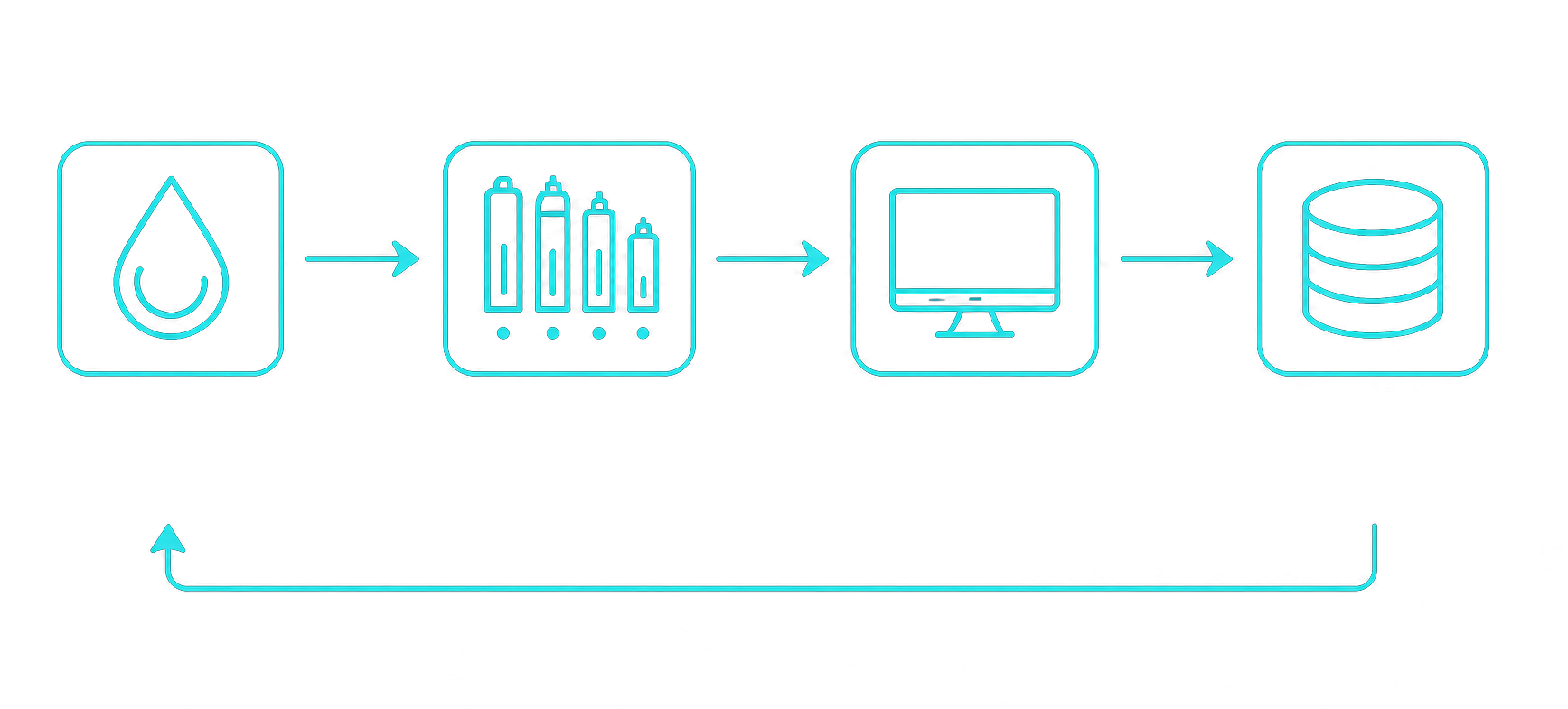
Digital control and data acquisition for the mode library to expand the capabilities of the technology

Possibility of integration into existing industrial water treatment systems
Preliminary results of laboratory tests
A series of experiments were conducted on a laboratory prototype of the system in Russia.
Different types of water were treated with different regimens.
Corresponding response groups were determined for each water composition:
| Mode B | ||||
|---|---|---|---|---|
| Parameter | Before treatment | After treatment | Approximate reduction | |
| Chromium VI | 0,17 | 0,05 | -71% | |
| Iron (Fe) | 0,29 | 0,11 | -62% | |
| Chromium (III) | 0,20 | 0,06 | -70% | |
| Lead | 0,110 | 0,002 | -98% | |
| Mode C | ||||
|---|---|---|---|---|
| Parameter | Before treatment | After treatment | Approximate reduction | |
| Turbidity | 6,83 | 0,65 | -91% | |
| Iron (Fe) | 0,40 | 0,06 | -85% | |
| Chromium (III) | 0,78 | 0,10 | -87% | |
| Chromium VI | 0,10 | 0 | -100% | |
| Nitrates | 62,0 | 43,7 | -30% | |
| Lead | 0,110 | 0,002 | -98% | |
| Mode A | ||||
|---|---|---|---|---|
| Parameter | Before treatment | After treatment | Approximate reduction | |
| pH | 7,7 | 7,0 | -9% | |
| Copper | 0,13 | 0,07 | -46% | |
| Turbidity | 6,83 | 0,65 | -91% | |
| Iron (Fe) | 0,76 | <0,05 | -93% | |
| Chromium (III) | 0,78 | 0,10 | -87% | |
| Chromium VI | 0,10 | 0 | -100% | |
| Nitrates | 1,75 | 1,31 | -25% | |
| Sulfates | 251,6 | 205,5 | -18% | |
| Zinc | 0,90 | 0,39 | -57% | |
| Phosphates | 0,92 | 0,22 | -76% | |

The examples show that different groups of elements respond to each processing mode. The obtained data require statistically significant confirmation.
Scientific basis and patent protection
The technology is based on the results of joint research with Tula State University and the Novomoskovsk branch of the D.I. Mendeleyev University of Chemical Technology of Russia. Its potential has received positive reviews from independent experts.

Currently, a provisional patent application dated July 20, 2026, number 64/115,308 has been received in the USPTO for an international (American) patent "System and method for desalination and purification of water using resonant vortex processing"

Conclusion
The main objectives of the current stage are:

Creation of a laboratory prototype of the installation to carry out the required volume of experimental work.

Creation of a library of modes and an algorithm for automatic mode selection based on it.

Confirm the claimed potential benefits of the technology.