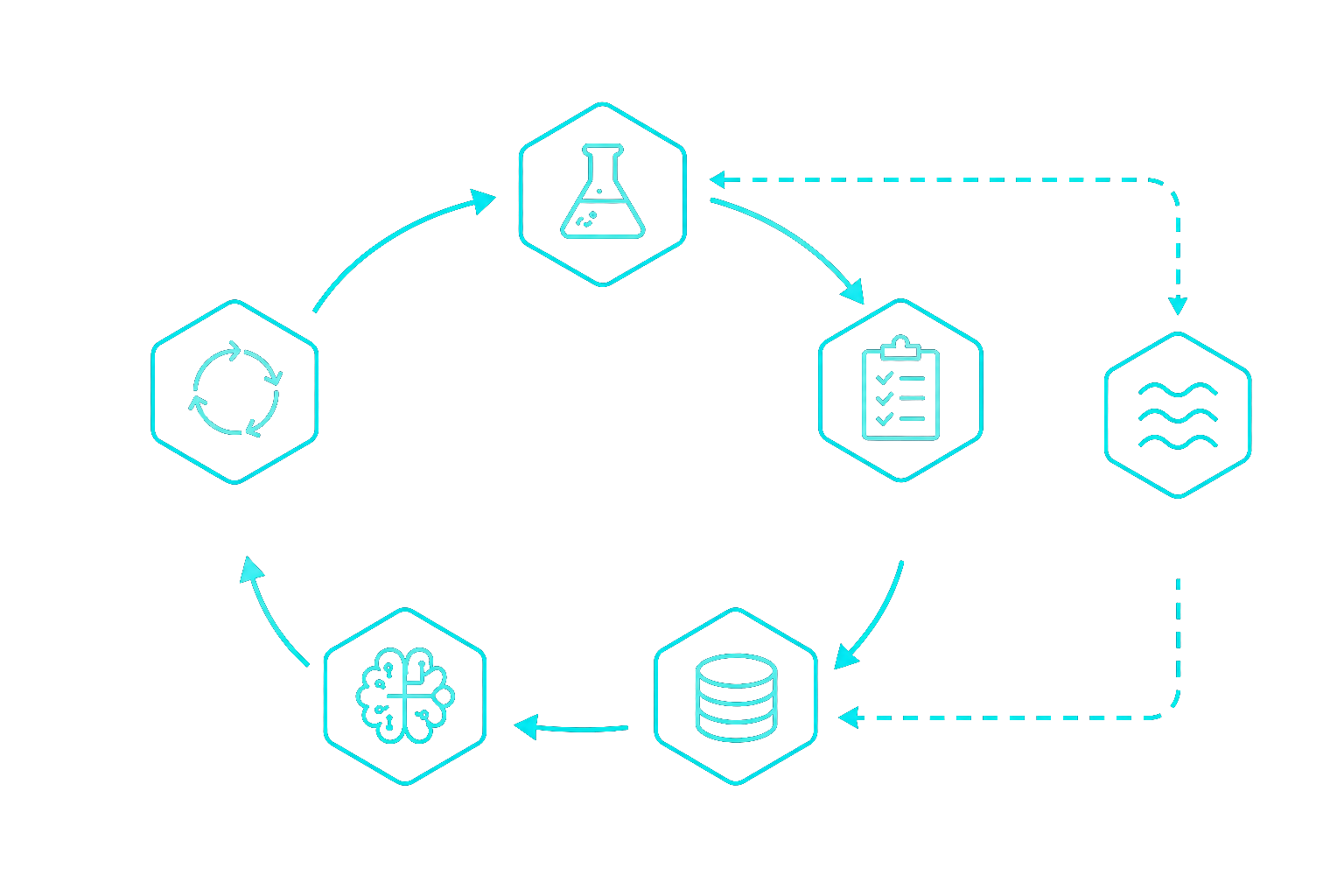
How the technology works
From water environment analysis to treatment mode selection
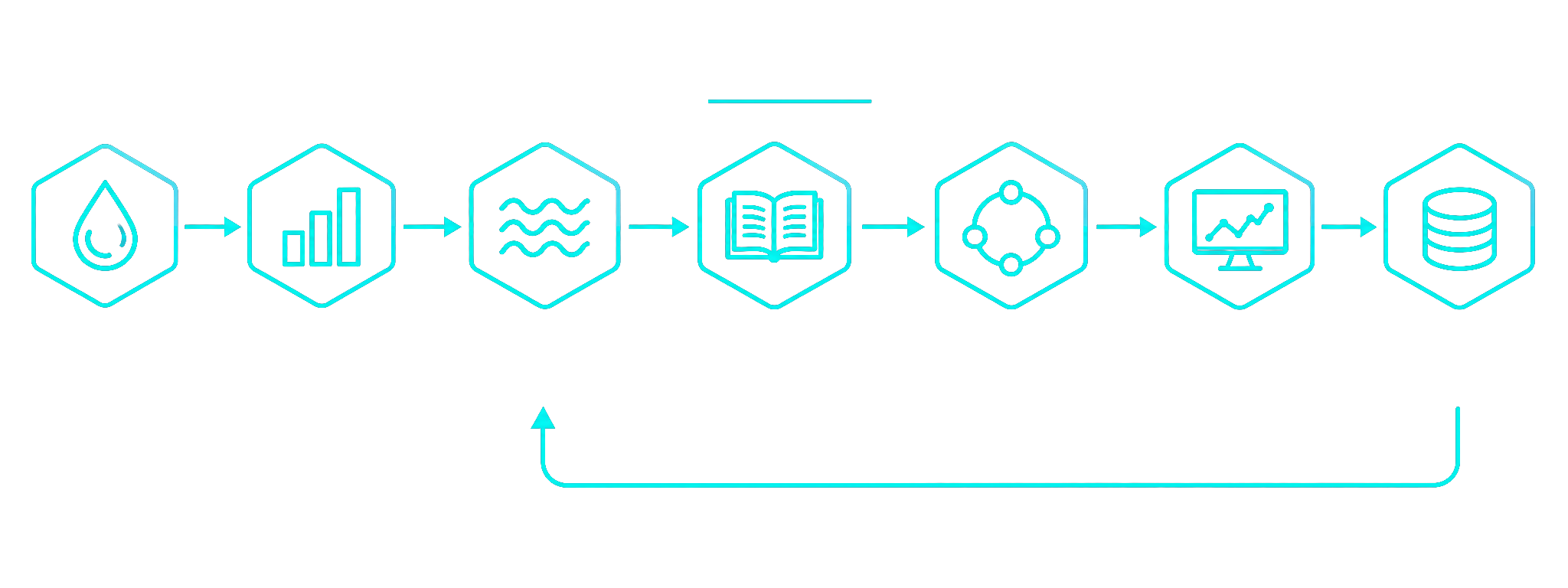

1. Initial aquatic environment
Each treatment cycle begins with an analysis of the source water.
The water being treated can vary significantly in its origin, chemical composition, dissolved solids concentration, suspended solids content, and other characteristics.

2. Formation of a digital profile
Before selecting a mode, a digital profile of the water being analyzed is generated.
This profile is a standardized description of the aquatic environment, including a set of physical, chemical, and technological parameters necessary for subsequent analysis.
This profile allows various types of aquatic environments to be presented in a unified format suitable for comparison and processing.

3. Search for similar profiles
The resulting profile is compared with profiles accumulated in the experimental data library.
The goal of this stage is to identify previously studied aquatic environments with similar characteristics.
Using similar profiles allows one to rely on previously obtained experimental results when selecting a processing mode.

4. Selecting the processing mode
After analyzing the identified analogs, the treatment regimen that best suits the characteristics of the water being studied is determined.
The selection is based on:
- aquatic environment parameters;
- results of previous experiments;
- treatment conditions;
- reproducibility of previously obtained results.
At the current stage of development, regimen selection is considered as a decision support system based on experimental data.

5. Cascade processing
The selected mode is implemented in one or more sequentially operating modules.
Each module can use its own set of treatment parameters.
After completing one stage, the water enters the next module, where a different treatment mode is applied.
The number of cascades is determined by the objectives of the specific technological process.

6. Control of results
After processing is complete, the obtained results are analyzed.
Changes in aquatic parameters, the effectiveness of the selected mode, and the reproducibility of the obtained effect are assessed.
This data is used for further improvement of the technology.

7. Replenishment of the library of modes
All results from the experiment are stored in the project's data library.
For each experiment, the following are recorded:
- source water characteristics;
- selected treatment parameters;
- treatment conditions;
- post-treatment measurement results.
In this way, the library gradually expands and becomes the basis for selecting treatment modes for new aquatic environments.
Continuous development of technology
One of the project's features is that each new series of experiments not only allows us to evaluate the effectiveness of a specific processing mode, but also expands the experimental data base.
As information accumulates, the library of modes expands, parameter selection algorithms are refined, and the quality of the decision support system's recommendations improves.
Thus, the development of technology is based on the consistent accumulation of experimental data and their use in the design of subsequent processing modes.